
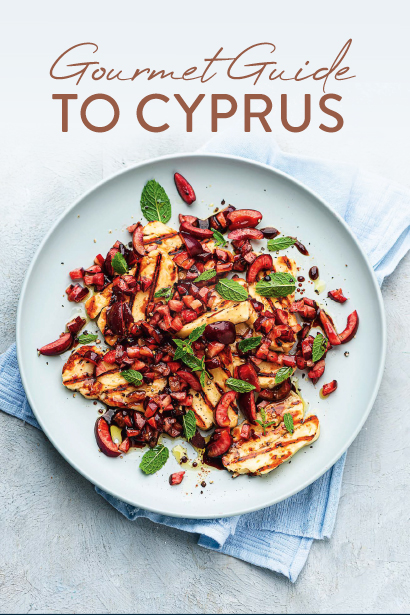
Salty, squeaky and synonymous with Cyprus, halloumi cheese is found on menus all over the Mediterranean island — and the world. In the southern region of Larnaca, it’s not just the country’s most celebrated export, but a way of life. Explore the process of making halloumi and how to best enjoy it.

Long-eared goats of Cyprus
TRADITIONAL METHODS FOR HALLOUMI MAKING
A flock of hungry goats with long, floppy ears and curved gray horns is jostling for position at the stable door as I inch forward, proffering a carob-seed pod. A white nanny goat with tufts of fluffy hair on her head pushes through the melee and snaps up the leathery brown pod, a favorite treat, devouring it in seconds.
It’s feeding time at Loulla Efthymiou’s family-run farm in Choirokoitia, a village in the Larnaca region of southern Cyprus, where the native carob — along with the evergreen mastic tree — is crucial for flavoring the sheep and goat’s milk that Mrs. Loulla (as she’s affectionately known) uses to make her much-loved halloumi.
“The farmers let the animals out so they eat the wild aromatic plants that we have here,” says tour guide Demetra Argyou Viguier, gesturing to the rocky, sloping hills dotted with dark-green shrubs that surround the farm. “The mastic tree has little berries and they also eat the carob leaves — that’s what gives the special flavor to the milk.”
Inside the white-walled dairy, Mrs. Loulla is about to begin the second step in the cheesemaking process with an important ritual. She lifts a large white paddle above a stainless-steel vat of milk that’s been mixed with rennet and heated gently to coax the curds from the whey, then plunges the slotted paddle into the creamy mass vertically then horizontally to make the sign of the cross.
“Religion is a part of our life in Cyprus,” Demetra explains. “She wants to have the presence of God with her in her work so that everything goes well.” Blessing complete, Mrs. Loulla — who, with the help of her sons, has been making halloumi here for 20 years using traditional techniques passed down from her parents — churns the curds to break them up. She transfers the milky mixture into a muslin-lined tray and gathers the fabric, squeezing so the liquid whey runs off — which is surprisingly satisfying to watch.

Halloumi wrapped in prosciutto
CHEESE TASTING
Originally made with unpasteurized milk, today the cheese — known worldwide for its distinctive rubbery texture — is pasteurized when mass-produced to adhere to modern standards. It’s the Mediterranean nation’s fourth-biggest export, and, in the U.S., sales are on the rise. In 2021, halloumi (or hellim as it’s called on the Turkish side of the divided island) was awarded PDO (Protected Designation of Origin) status by the European Commission, meaning only cheese produced in Cyprus, to certain specifications, can bear the name.
“Halloumi is synonymous with Cyprus,” culinary expert and author Marilena Joannides tells me later. “The origin can be traced back to ancient history — it’s listed among some of the world’s oldest-known cheeses.”
Mrs. Loulla and her sons, who help tend to the 300 livestock, work 365 days a year to keep their customers happy — some of them travel for miles to stock up on the cheese. And there’s no need for fancy labels or advertising — the finished product speaks for itself, as I discover when I sit down at the dining table in the farmhouse. Photos of Mrs. Loulla’s seven children and 15 grandchildren are proudly displayed on the walls. Shortly after I’ve taken my seat, a magnificent spread is laid out before me on a rose-print tablecloth. I can feel my mouth beginning to water as Mrs. Loulla sets down plates of halloumi slices (fresh from the latest batch) alongside chunks of peeled cucumber, wedges of tomato, marinated black olives, a loaf of brown bread and a pot of runny golden honey. Following Demetra’s lead, I lay a juicy piece of halloumi on a slice of sesame-encrusted bread and drizzle it with a dash of honey. The combination of salty, soft cheese with the crusty bread and sweet topping is heavenly. The subtly minty flavor of the halloumi (the herb is added before the blocks of cheese are cooked for the second time) also goes beautifully with the crunchy vegetables and the tangy olives.

Limassol, Cyprus
WHERE TO EAT HALLOUMI IN CYPRUS
- Agios Epiktitos Taverna serves all the classics — souvlaki skewers, stuffed vine leaves, keftedes meatballs and, of course, halloumi. This picturesque taverna is perched on a hill in Armenochori village, offering stunning views to accompany a meal.
- The Breadhouse: Fill your basket with traditional Cypriot breads and halloumi-stuffed pastries at this well-stocked bakery and delicatessen in Limassol.
- Loved by locals, Melanda Beach Restaurant is a fish taverna on Pissouri Bay. It’s the place to go for cuttlefish, calamari or catch of the day grilled and served simply with olive oil, lemon and herbs.
- Iconic restaurant Ta Piatakia (Little Plates) in Limassol serves contemporary Cypriot cuisine. Here, a slice of halloumi cheese is wrapped in a thin slice of bacon and deep fried then served with a sweet mango chutney.
By Katie Wright


